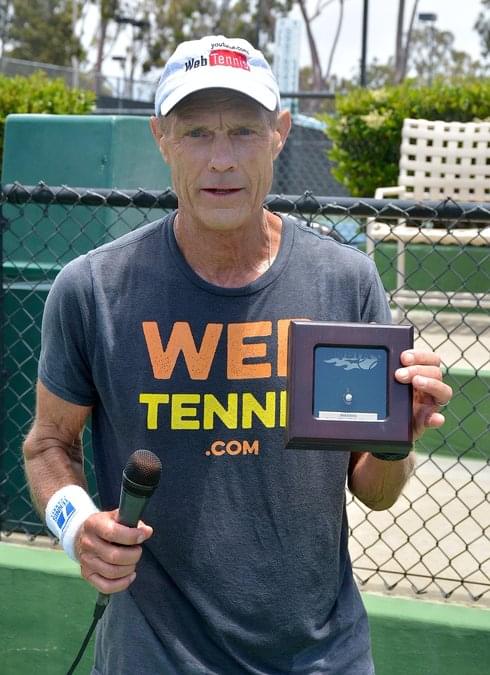
REPLAY: Webcast With Johan Kriek – Thu Aug 4, 3pm Pacific

WebTennis Players Workshop Members – get logged in —>

“Turning Your Transitional Shot Right After Your Serve Into A Weapon”
How To Go From A Liability To An Asset

LIVE Webcast Featuring Johan Kriek
(Webcast was held on Thursday August 4, 2011)

REPLAY PACKAGE &

BONUS Lesson:  Slice Serve Fundamentals

This webcast replay and the Slice Serve BONUS lesson are only available to WebTennis Players Workshop members.

If you are a member, get logged in —>.

Click here to find out why your tennis games is begging you to become a Players Workshop member!

Comments

  1. Shafik Mahomad says:

    Video 2 is the repeat of video 1 – oops

  2. Brent says:

    Hey guys. I gotta go to the Berkeley TC and hit some balls. Been sitting in front of this thang for the past 8 hours or so and my mind is just much.

    Will be back later to respond to your comments and questions.

    The BONUS lesson may take some time to work through, but really want to hear your feedback and questions on the slice serve.

    Either here or over at that lesson’s page.

    Thanks.

    Brent

  3. Rodger Schuester says:

    Today, in my match, I ended up with several balls at my feet, after my serve, that I tried to hit 1/2 volleys on. My thoughts were I probably could have moved forward a bit more and taken them more effectively as long volleys and that I should train myself to focus more on the long volley.

    The guy I played with suggested that after my serve, if it is not a strong serve, I would be better to step back a foot or so behind the baseline instead. I don’t like giving up my court position.

    Alternatively, I can try to improve my spacing, but I sense I might be split stepping with a bit too much cement in my shoes and not enough forward spring.

    Any thoughts Brent?

    • eric carlson says:

      Hey Rog..the guy is right if He is a strong player…For instance,,
      If you serve to me ( a 4.5) and fall into the court Im gonna drill it back to your feet and follow in for an easy volley off of your weak return from your feet.,
      If you hit a weaker serve you must maintain the best court position posible and stay on balance!
      Your immediately at a disadvantage so a quick back step into a split is correct….but…
      Remember not to end up in the middle of the court off your serve, you want to be three feet or so to the cross court return…this should really help you with positioning so that you have a better chance to neutralize his return of serve and start taking control of the point…
      I serve and volley most of the time….But only if I put the serve where I want it!!
      1) out wide deuce court, I come in and split cutting off the return angle
      2) down the T duece side I get in as far as possible and expect a weak back hand return
      3) Ad side down the T..I come in 2 steps and split and take the return and crush it wide (off a guys forehand return)…or if it is a short return I love to get in more and drop volley away from him
      4) Out wide Ad side—Im coming in following the shot exactly to cut off all angles of return…volley!
      Rog…If I miss into the guys wheelhouse I’m not going anywhere! I step back into the split and reset!
      Hope this helps you!

      Brent?

      • Rodger Schuester says:

        Thanks Mucho Eric – really nice we can kick this stuff around and get various perspectives – your comments went into my notes file for deeper consideration. Even at the 4.0 level, the guys don’t give fellow players a lot of room for lack of craftsmanship mistakes.

        “drill it back to your feet and follow in for an easy volley off of your weak return from your feet.” Or worse, just busts me out at my feet. That is exactly what has been happening to me more at the 4.0 level. At the 3.5 level it was vary occasional and seemed to be more of a failure of technique on my part, rather than what it really is now beginning to seem to be – a court positioning failure off a serve that for that particular opponent comes off as a weak serve relative to their better return of serve skills.

        Also, appreciate the second thought on prepared to neutralize and take control of their return.

        Again thanks for your thoughts on s & v options.

        One thing Eric, when I complete an s & v all the way through to taking the point at the net, it is a wonderful experience, a much better feeling from my perspective than trying to drive through my opponent or hit winners from the baseline – really adds to ones confidence.

        That’s another topic Brent – best court positions for varying circumstances.

    • Brent says:

      Hey Rodger and Eric.

      Good back and forth. Eric – good suggestions for the different serve placements, HOWEVER, the best place to serve throughout the match is directly at the body.

      I go there about 70% of the time.

      I then mix in the out wide and T locations.

      Rodger – If your opponent is consistently forcing you to decide to volley or 1/2 volley, then I’d prefer to have you split sooner so you can get a ball that bounces up into a nice comfortable approach type of shot.

      There’s no value for reaching forward for a volley so you can avoid the 1/2 volley. That gets you off balance as you play the shot (tough to control) and you don’t get to that next court position efficiently.

      Whatever you play, a transitional volley, 1/2 volley, or an approach, none of those are one shot put away situations.

      You’re always thinking it’s going to be at least a 2 shot play. Make your transitional shot on balance so you can efficiently move to the next ideal court position depending on where you’ve just played that transitional shot.

      Brent

      • Rodger Schuester says:

        Thanks again Brent, splitting sooner was not something I had considered. Actually, I’m just now getting better doing more splitting. Easy to get lazy.

        • Brent says:

          Well, it’s also easy to think that you have to get super close, inside the service line to make that 1st volley, and that’s just no realistic.

          It might be a reality if you play a very high topspin serve AND your opponent stays way back to return serve. Yes, then you might have enough extra time to get to that service line.

          BUT, if you play a normal speed serve and the returner is receiving it on their baseline or inside, there’s no way you can realistically get up to your service line to make that 1st volley.

          Unless it’s a high floater return, then you might want to be closer to the net for your 1st volley, but if the return is down below the top of the net when you make contact AND you’re close to the net, that’s not great geometry for your 1st volley.

          Brent

          • eric carlson says:

            more great advise from our on-line coach!

            I find most of my volleys off serve occur 3-4 feet behind the service line to the service line at best !!
            Theres no way I can this bag of flesh from the baseline to inside the service line for a volley off serve!

          • Brent says:

            That one took me awhile to feel comfortable with. Accepting the reality that I was rarely if ever going to be able to get to or inside the service line for my 1st volley.

            Choose whatever shot helps you maintain good balance so you can be consistent and more efficiently move to the next ideal court position.

            Brent

      • eric carlson says:

        I really took your advise on this a year ago! 70% to the body….Mostly in doubles,…I really agree..

        Singles I lower that to 40-5o%…Do you really want me to go back to 70% in singles?

        I really like to mix up my serve depending on oponents receiving position..and I have a lot of different serves..but, maybe thats ego getting in the way :)
        My Favorite serve is power (left to right)…I hit it at my oponents right leg and it kicks into his body ( i try to punish his right hip) setting up weak returns…then go wide to either side…bad strategy you say?

        • Brent says:

          Hey Eric – It’s natural to want to play serves that are unreturnable, meaning that we go either to the T or out wide.

          Unfortunately, the reality is that we miss to many of those, then have to play 2nd serve, and our confidence takes an immediate to the start of that point.

          One of the benefits of an ‘in play’ high percentage 1st serve is that you start the point with confidence.

          So, if I’m going to think of playing a serve that has a power level of something in between my normal 1st and a safe spin 2nd, my consistency goes up on my 1st serve and I feel more confident throughout the rest of the match.

          I’m 70% to the body unless the guy has a huge weakness…

          Brent

          • Rodger Schuester says:

            One of the things I try to do is hit both first and second serves with the same level of power – I think I end up in between the big 1st and safe 2nd. Yeah, I vary things too, but that’s my dominant mode and I like putting in a fairly good 2nd serve confidently if I have to serve twice.

            I also have adopted a disappointment personality when either my opposite fails to get my serve back or a server fails to hit their serve to me. I want to hit balls and build points, to have the confidence to “toy” with my opponents, not feel the need to end points quickly or win off freebees.

            My goal is to trust my normal stroke – that it is plenty good enough to put me in a position to win the point. Instead of changing to a different intent or stroke pattern when presented with an offensive shot, I’m trying to use the same intent and relative stroke speed I would as if the shot were not hit for a winner.

            I want to play more consistently and with less pressure, at all phases of a point.

  4. Rodger Schuester says:

    I like the way you structured the bonus lesson. What’s different about it, is that you opened up your mind to us as to how you think as the process unfolds. That is a very unique way to teach and I think extremely valuable. You aren’t simply providing stroke or strategic/tactical advice.

    I can’t say I bought into the visualization early on, but I started it last night before my match and am beginning to get the message as to its value. I was thinking I should be visualizing moving up to long volley before I serve and where they are apt to return based on past responses.

    It is early into Ian’s fitness primer, which is what he offers as a bonus before the formal start of class in two more weeks, but I have been doing a lot more lunges and squats. Today I was getting down much lower than usual – so low that for one low slice I actually gently went too far down and touched me knee to the ground, so I was all arms in the shot.

    I thought it was kind of funny at the time – I think it is because a habit is beginning to form – getting use to getting down lower.

    • Brent says:

      RS – Good. Glad you liked the slice serve lesson.

      Right, visualization before you serve can help minimize the possibilities in your mind and help you concentrate more on playing a clean & efficient serve.

      I don’t really visualize past the serve and the return possibilities. I never think about winning or losing the point, I just see the ball going to my intended target.

      Brent

  5. eric carlson says:

    Brent I cannot get into the webinar you held last week. It wont just open…It asks me to log in
    for some reason?

    • Brent says:

      That’s right. You have to log in with your WebTennis Players Workshop member username and password to see the webcast replay.

      Send me an email to askbrent@webtennis.net if you need me to send you your login info.

      Brent

  6. alv123 says:

    Hi,

    I tried several times to download the tennis slice serve but no voice can be downloaded. please advise.

Trackbacks

  1. [...] To Register For This Live Webcast With Johan Kriek, Click Here [...]

Speak Your Mind

Notify me of followup comments via e-mail. You can also subscribe without commenting.